Valuation vs. Insurance in Office Moves: What’s the Difference?
When planning an office move, protecting your furniture, IT equipment, and assets is just as important as coordinating logistics. One of the most misunderstood parts of that protection is valuation coverage.
- Valuation is not insurance—it defines the maximum liability your moving company assumes
- It applies only when damage results from mover negligence
- There are typically different levels of valuation, offering varying degrees of protection
- Choosing the right option depends on your risk tolerance, asset value, and business needs
Understanding valuation upfront helps avoid surprises and ensures you’re making informed decisions before your move begins.
Why Protection Matters in an Office Move
Office relocations involve far more than moving desks and chairs. Today’s workplaces include high-value IT infrastructure, specialized equipment, confidential files, and custom furniture—all of which require careful handling.
Even with an experienced commercial mover, risk can’t be eliminated entirely. Elevators malfunction, tight hallways create challenges, and sensitive equipment requires precise coordination. That’s why protection options exist—to define how responsibility is shared between the moving company and the client.
This is where valuation coverage comes into play.
What is valuation in an office move?
Valuation is the maximum amount a moving company is liable for if your items are damaged during a move due to their negligence. It is not insurance and does not guarantee full replacement value.
It is important to understand that valuation:
- Is part of your moving contract
- Establishes liability limits
- Applies only if the mover fails to exercise reasonable care
- Is not designed to guarantee full replacement value in all cases
In simple terms, valuation answers the question:“If something is damaged due to the mover’s handling, how much can I recover?” The answer depends on the valuation option you select.
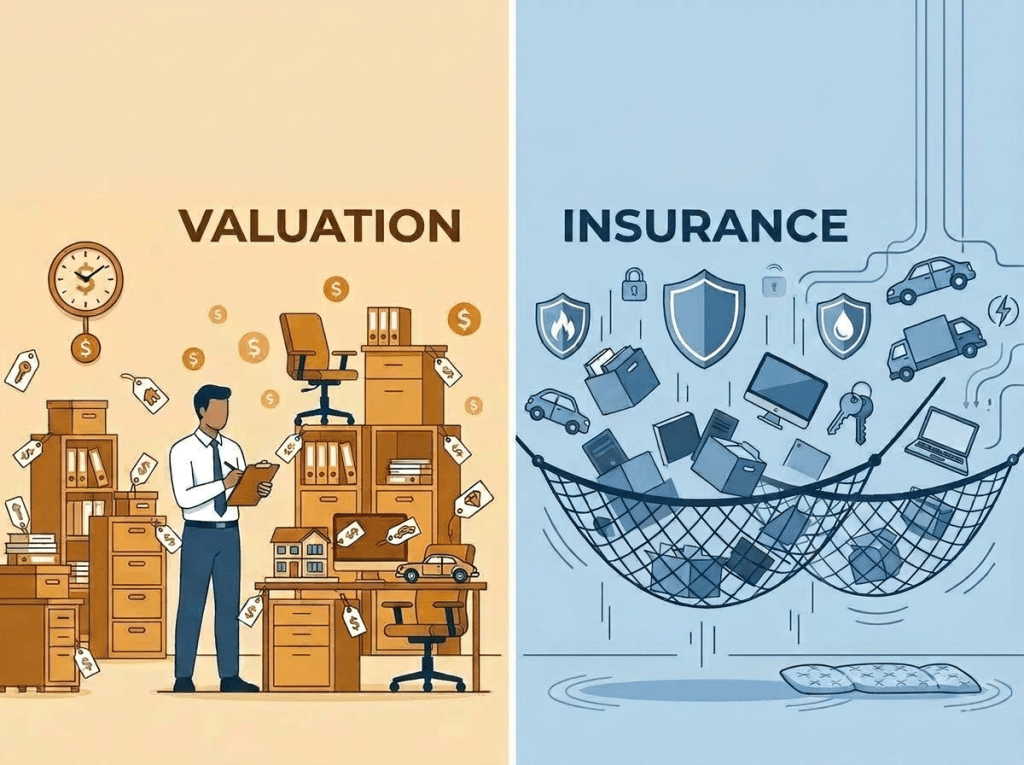
Valuation vs. Insurance: The Critical Difference
One of the most common misconceptions in commercial moving is that valuation equals insurance. It does not.
Valuation
- Provided by the moving company
- Defines limited liability
- Applies only in cases of proven negligence
- Includes caps, exclusions, and conditions
Insurance
- Purchased through a third-party provider
- Can offer broader protection depending on the policy
- May cover a wider range of risks (including some outside the mover’s control)
- Typically offers more customizable coverage
Think of valuation as a baseline level of protection built into your move, while insurance is an additional layer of financial protection you can choose to secure independently. For many businesses, understanding this distinction is key to properly managing risk.
Feature
Provider
Coverage Type
Applies to
Customization
Valuation
Moving Company
Limited liability
Negligence only
Limited
Insurance
Third-party insurer
Policy-based coverage
Broader risks (varies)
Flexible
Why Valuation Exists in Commercial Moving
Valuation exists to create a clear and fair framework for risk.
Without it, moving costs would increase significantly, as companies would need to assume unlimited liability. Instead, valuation:
- Keeps moving services cost-effective
- Defines expectations upfront
- Encourages clients to assess their own risk tolerance
- Aligns with industry standards for commercial moving
It’s a practical system that balances affordability with accountability.
Office Movers Express Valuation Options
At Office Movers Express, we offer two valuation options designed to align with different levels of risk and asset value: Standard Valuation and Extended Valuation.
Standard Valuation (Included Coverage)
Coverage details include:
- $1.00 per pound per item for furniture
- $5.00 per pound per item for electronics
- Maximum of $250 per item
- Building damage capped at $500 per claim
Important Exclusions
- Intrinsic or sentimental value
- Fine art and antiques
When It Makes Sense
Standard Valuation is typically appropriate for:
- Lower-value furniture and equipment
- Internal office moves
- Projects where items are easily replaceable
This option provides essential protection, but it is limited – especially for higher-value items.
Extended Valuation (Enhanced Protection)
Extended Valuation offers a higher level of coverage for businesses that need greater protection.
Cost Structure
- $12.50 per $1,000 of declared value
- Minimum declared value: $25,000
- Maximum declared value $100,000 (in $5,000 increments)
- $250 deductible per claim
How Claims Are Evaluated
Loss or damage is based on the lesser of:
- Cost to repair the item, or
- Cost to replace with similar property of like kind, quality, and condition
Key Conditions
- Maximum of $10,000 per individual item
- Items valued at $5,000 or more must be itemized and submitted within 1o days
- Claims must show visible damage or identifiable mishandling
- Building damage capped at $5,000 per claim
When It Makes Sense
Extended Valuation is ideal for:
- Offices with high-value furniture or specialized equipment
- Technology-heavy environments
- Law firms, healthcare facilities and executive spaces
- Businesses where downtime or replacement costs would be significant
This option provides a more robust level of protection – but still within defined limits.
What Valuation Does NOT Cover
To make informed decisions, it’s just as important to understand what valuation does not cover.
Valuation does not apply to:
- Events beyond the mover’s control (fire, flood, acts of God)
- Items with intrinsic or sentimental value
- High-value items that were not properly declared
- Claims exceeding the declared valuation amount
Additional considerations:
- The customer is responsible for proving damages
- Installation-related claims must be reported within 5 days of move completion
- Any loss exceeding the declared value is the customer’s responsibility
This reinforces why valuation should be viewed as limited liability—not comprehensive protection.
How to Choose the Right Valuation Option
Selecting the right valuation comes down to balancing risk and cost.
Key Factors to Consider
- Total value of items being moved
- Sensitivity of equipment (IT systems, medical devices, etc.)
- Potential business disruption if items are damaged
- Budget and risk tolerance
A Simple Framework
- If your office contains standard, easily replaceable items, Standard Valuation may be sufficient
- If your business relies on high-value or critical equipment, Extended Valuation is often the smarter choice
Ultimately, the goal is to align your coverage with the real-world impact a loss would have on your operations.

Common Misconceptions About Moving Coverage
Let’s clear up a few common misunderstandings:
- “My move is fully insured.”
Not necessarily—valuation is not the same as insurance. - “Everything is covered.”
Valuation includes limits, caps, and exclusions. - “If something is damaged, I’ll be reimbursed.”
Only if negligence is proven and within valuation limits. - “Declared value guarantees full replacement.”
Claims are typically based on repair or like-kind replacement—not brand-new cost.
Understanding these nuances helps prevent unexpected outcomes.
Final Thoughts: Protecting Your Business Beyond the Move
Valuation coverage is ultimately about clarity and shared responsibility.
It ensures that both the moving company and the client understand:
- What is covered
- What is not
- How risk is distributed
The most successful office moves combine:
- An experienced commercial moving partner
- Detailed planning and coordination
- The right level of valuation coverage for your business
If you’re planning an office move, taking the time to understand your options now can save time, cost, and stress later.
Key Takeaways
- Valuation is limited liability—not insurance
- Coverage applies only to mover negligence
- Standard valuation offers minimal protection
- Extended valuation provides higher coverage with conditions
- Businesses should assess risk before selecting coverage
FAQs: Valuation vs. Insurance in Office Moves
Is valuation required for an office move?
Yes. You must select a valuation option as part of your moving agreement. If no extended value is declared, standard valuation is typically applied by default.
Can I purchase additional insurance?
Yes. Businesses can work with third-party insurance providers to secure additional coverage beyond the mover’s valuation limits.
What happens if I don’t declare value above the minimum?
If you do not declare a value above the minimum required for extended coverage, your move will default to Standard Valuation.
How are claims handled?
Claims must demonstrate that damage resulted from the mover’s failure to exercise reasonable care. Documentation and visible damage are typically required, and timelines (such as 5 days for installation-related claims) must be followed.
What is the most important factor when choosing valuation?
The biggest factor is the potential impact on your business if items are damaged. Higher-value or mission-critical assets generally justify higher levels of coverage.
Every office move is different—and so is the level of protection that makes sense. Our team can help you evaluate your inventory, risk exposure, and timeline to recommend the right valuation approach for your business.